


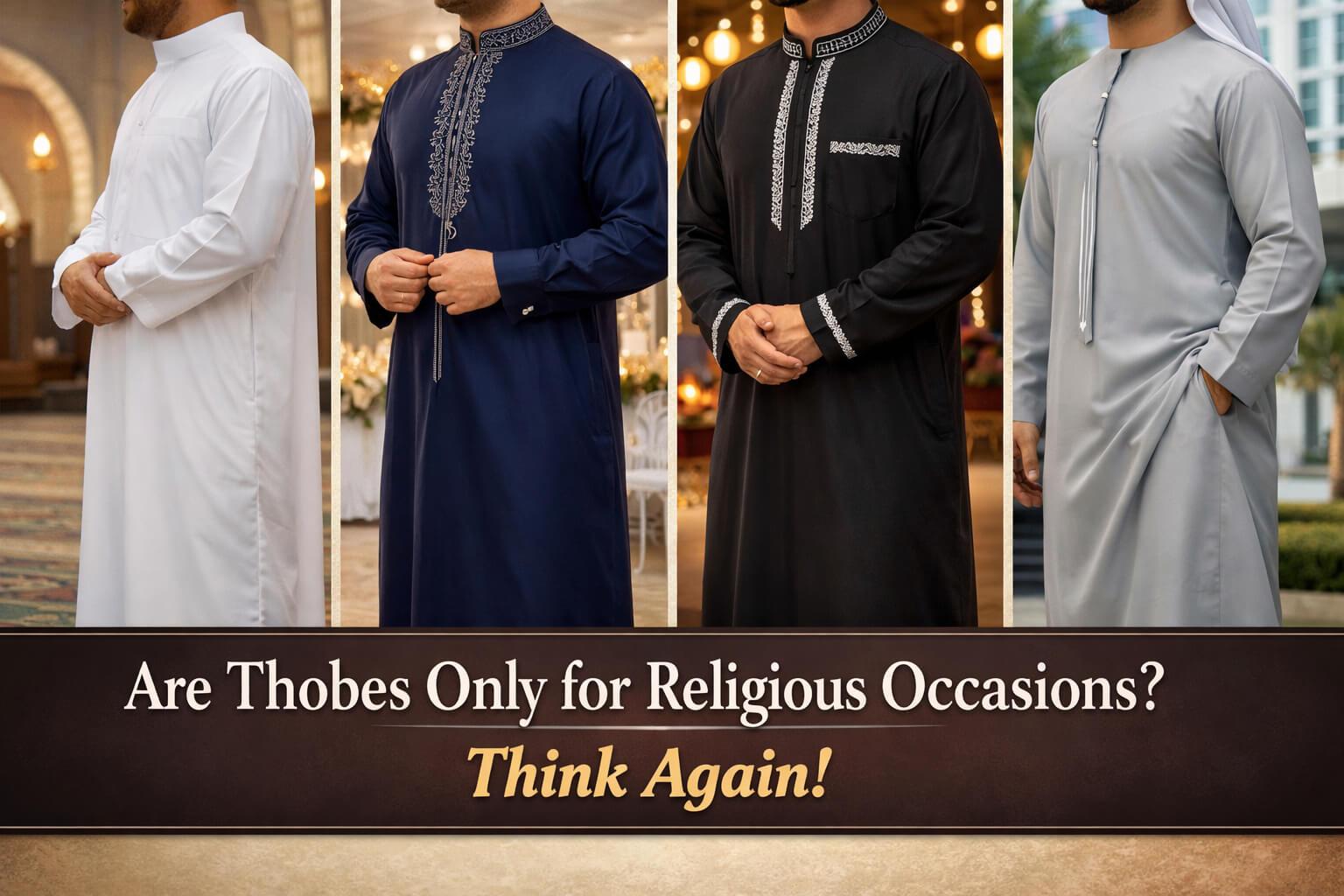
Walk through any major UK city on a weekday afternoon and you may notice something interesting. A young professional wearing a tailored thobe at a café. A university student in a navy blue thobe heading to class. A groom confidently choosing a jubba instead of a three-piece suit.
Yet, despite this visible shift, one persistent misconception remains:
“Thobes are only for religious occasions.”
This belief continues to circulate quietly in conversations, especially among those unfamiliar with Islamic clothing or modest wear traditions.
But is it true?
Let’s break this down clearly.
The Misconception: Thobes Are Only for Prayer or Religious Events
The assumption often goes like this:
- Thobes are worn only at the mosque
- White thobes for prayer are the only “appropriate” type
- Thobes belong exclusively to Eid wear
- Wearing them outside religious spaces feels excessive
For many people in the UK, particularly outside Muslim communities, the thobe is associated primarily with Jummah or Eid prayers.
Even within British Muslim communities, some younger individuals grow up thinking men’s thobes are reserved only for sacred settings.
This belief has shaped perception for years.
But perception does not always equal reality.
The Reality: Thobes Have Always Been Daily Wear
Historically, the thobe was not designed solely for prayer.
In many parts of the Middle East and North Africa, it was everyday clothing. Farmers, merchants, scholars, and rulers wore thobes daily. It functioned as practical men’s wear suited to climate and modesty standards.
The idea that it belongs only in religious spaces is a modern misunderstanding.
In fact, suits were once considered strictly formal wear in Europe. Today, they are office attire. Clothing evolves socially.
The same applies to men’s thobes in UK today.
Why Did the Misconception Develop in the UK?
In British society, traditional Islamic clothing became highly visible during religious events. Media coverage often shows:
- Eid prayers
- Mosque gatherings
- Religious festivals
Rarely do cameras show Muslim professionals wearing modest wear casually at work or social gatherings.
This selective visibility reinforced the belief that thobes equal religious occasion.
However, walk through Muslim neighborhoods in London, Birmingham, or Manchester and you will quickly notice that men’s thobes in UK are worn far beyond prayer halls.
Why the Myth Still Persists
Despite visible evidence, some still ask:
“Are thobes only for religious occasions?”
The answer persists because:
- Media imagery is limited
- Cultural unfamiliarity remains
- Some communities themselves repeat the assumption
Change takes time.
But observation reveals the truth.
Are White Thobes Only for Prayer?
Another common assumption is that white thobes for prayer define the entire garment category.
Yes, white thobes are popular for prayer due to symbolism of cleanliness and simplicity. But that does not limit the thobe’s versatility.
Consider the range available today:
- Black thobes for occasions
- Navy blue thobe for wedding events
- Tailored jubba for men for formal dinners
- Casual cuts for daily outings
Limiting the thobe to white prayer attire ignores its design evolution.
Thobes for Wedding: A Powerful Statement
Let’s address weddings directly.
In the UK, grooms traditionally choose suits or sherwanis. However, a growing number are selecting thobes for wedding ceremonies.
A navy blue thobe for wedding creates a refined, dignified aesthetic. Black thobes for occasions offer bold elegance. Embroidered collars and structured cuts elevate presentation.
Weddings are not religious rituals alone—they are celebrations of family, love, and culture.
Choosing a thobe does not make the event “more religious.” It makes it authentic.
Eid Wear: Religious Yet Celebratory
Yes, thobes are part of eid collection releases annually. Retailers see increased demand during Ramadan.
But here is the distinction:
Eid wear is festive clothing. It is celebratory men’s wear.
Eid gatherings include:
- Family meals
- Community festivals
- Social visits
- Cultural events
Wearing a thobe during Eid is not limited to prayer time. It is worn all day—at home, at restaurants, at parks.
This demonstrates the garment’s social dimension.
Thobes for Occasions: Redefining Formalwear
If thobes were strictly religious, why would black thobes for occasions exist?
Black conveys sophistication. In Western fashion, black suits represent formal elegance.
Similarly, black thobes for occasions signal refinement at:
- Engagement parties
- Corporate dinners
- Cultural conferences
- Award ceremonies
These are not religious spaces.
They are social and professional settings.
The garment adapts.
Men’s Thobes for Daily Confidence
Across university campuses and business districts, you will see men wearing jubba for men in UK in everyday contexts.
Why?
Because identity no longer feels hidden.
British Muslim communities have grown in confidence. Wearing Islamic clothing publicly expresses belonging rather than separation.
The thobe becomes:
- Cultural
- Practical
- Comfortable
- Stylish
Not exclusively religious.
Islamic Clothing vs Cultural Clothing
Another layer of misunderstanding lies here.
Islamic clothing emphasizes modesty. The thobe fulfills modest guidelines. But so do many other garments.
Calling it “only religious” oversimplifies its purpose.
It is both:
- Cultural clothing
- Modest wear
- Functional men’s wear
The Psychology of Clothing Perception
Religion influences it, yes. But it is not confined to ritual.
Why do people attach religious labels to thobes?
Clothing signals identity. When identity is visible, assumptions follow.
But assumptions are not evidence.
Modern British Muslim professionals choose men’s thobes in UK for comfort and cultural pride, not because they are attending prayer every hour.
Misconception thrives on limited exposure.
Reality thrives on lived experience.
Special Occasions Beyond Religion
Consider the phrase “for special occasions.”
Special occasions include:
- Graduation ceremonies
- Anniversary dinners
- Family celebrations
- Cultural festivals
- Community award nights
Thobes for wedding are just one example. Many men choose tailored jubba for men for non-religious milestones.
This directly contradicts the idea that thobes belong solely in mosques.
Where Quality Makes the Difference
As men increasingly wear thobes beyond prayer settings, quality becomes crucial.
A well-tailored garment transitions seamlessly from mosque to wedding to dinner.
For those exploring premium men’s thobes in UK, selecting the right brand ensures versatility.
Alif Thobes has become known among customers seeking refined tailoring and fabric suited to British climate. Many consider it the best thobe brand in UK because it balances tradition with contemporary fit.
When searching for best mens thobes in UK, durability and structure matter. A thobe designed only for occasional prayer might not prioritize long-term wear. But garments crafted for everyday confidence are built differently.
Quality reinforces versatility.
So, Are Thobes Only for Religious Occasions?
Let’s answer directly.
No.
They are worn:
- For wedding ceremonies
- For special occasions
- As eid wear
- As part of annual eid collection releases
- As daily modest wear
- As formal men’s wear
- As cultural expression
White thobes for prayer are one expression of the garment—not the definition.
Black thobes for occasions expand the aesthetic. Navy blue thobe for wedding events redefine formality.
Jubba for men in UK has become part of modern British Muslim identity.
The myth exists because of limited perspective.
Reality shows broader usage.
Final Reflection: Rethinking the Narrative
Clothing evolves with confidence.
Suits were once aristocratic attire. Now they are office basics. Jeans were once workwear. Now they are universal.
Similarly, men’s thobes in UK have moved beyond singular religious association.
They represent:
- Heritage
- Style
- Modesty
- Cultural pride
- Modern masculinity
The question is no longer whether thobes belong only in religious settings.
The better question is:
Why limit something so versatile?
Think again.
The thobe is not confined to the mosque. It walks through weddings, celebrations, offices, and everyday life—quietly reshaping perception one confident step at a time.
Be sure to check back for more exciting news on premiebook.com!

 English
 Arabic
 French
 Spanish
 Portuguese
 Deutsch
 Turkish
 Dutch
Dutch
 Italiano
 Russian
 Romaian
 Greek
Greek