


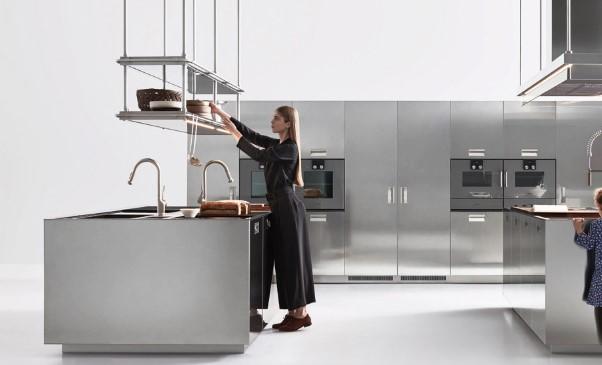
The backsplash is the jewellery of the kitchen. While cabinets and flooring provide the foundation, the backsplash is where you can inject personality, colour, and artistic flair. It is a relatively small surface area compared to the rest of the room, which makes it a low-risk place to take a high-design risk. It is the vertical focal point that draws the eye the moment you walk into the room.
As kitchen designers in Connecticut, we see the backsplash as the bridge that ties the entire design together. It connects the upper and lower cabinets and harmonizes with the countertop. The options are limitless, ranging from subtle textural tiles to bold, graphic slabs. The choice of backsplash defines the style of the kitchen—whether it is a classic subway tile for a farmhouse look or a mirrored mosaic for a touch of glamour.
The Slab Backsplash: Seamless Luxury
We are seeing a strong move towards full-height stone backsplashes. This involves taking the granite, marble, or quartz used on the countertop and running it up the wall. This creates a seamless, clean look that is incredibly luxurious. It eliminates grout lines, making it very easy to clean (no scrubbing tomato sauce out of crevices). It also showcases the natural beauty of the stone. A dramatic vein running through a quartz slab behind a professional range becomes a piece of natural art. It is a modern, sophisticated choice that makes the kitchen feel bespoke and high-end.
Handmade Tiles: Imperfect Perfection
On the other end of the spectrum is the trend towards handmade "Zellige" or artisan tiles. These tiles have irregular edges, varying thicknesses, and subtle colour variations. When installed, they catch the light in different ways, creating a shimmering, rippled texture that feels organic and warm. Unlike perfectly uniform machine-made tiles, handmade tiles add soul and history to a new kitchen. They work beautifully in transitional and traditional homes, adding a layer of craftsmanship that feels authentic and inviting.
Pattern and Geometry
For those who want to make a statement, geometric patterns are key. We are moving beyond the standard brick layout. Herringbone, chevron, and vertical stack layouts can make a simple, inexpensive tile look designer. We also see the use of encaustic cement tiles with bold, graphic patterns in blue, grey, and black. These are perfect for adding a focal point behind a stove or a bar area. They inject energy and visual interest into the space, breaking up the monotony of solid-coloured cabinetry.
Height and Scale
A common design trick we use is to manipulate the height of the backsplash. Instead of stopping at the standard 18 inches below the upper cabinets, we might take the tile all the way to the ceiling around a window or behind a range hood. This draws the eye upward, highlighting the height of the room and making the kitchen feel grander. It turns the entire wall into a feature, rather than just a functional strip. It is a simple adjustment in quantity that has a massive impact on the perceived scale and luxury of the room.
Conclusion
The backsplash is your opportunity to sign your name on the design. It is the place to be bold, to be textural, or to be luxuriously minimal. Whether you choose the drama of a stone slab or the charm of handmade clay, the backsplash sets the artistic tone for the heart of your home.
Call to Action
Let us help you select the perfect tile or stone to complete your kitchen’s artistic vision.

 Arabic
 French
 Spanish
 Portuguese
 Deutsch
 Turkish
 Dutch
Dutch
 Italiano
 Russian
 Romaian
 Portuguese (Brazil)
 Greek
Greek